
What Is a High-Voltage Powertrain?
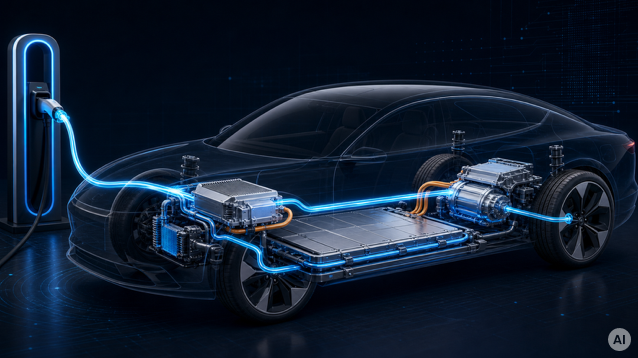
An electric vehicle (EV) powertrain is the system that converts electrical energy stored in the battery into mechanical energy at the wheels. It typically includes the battery, power electronics (inverter and charger), electric motor, transmission, thermal management system, and control software.
A high-voltage powertrain refers to architectures operating at 800 volts or higher, compared to traditional EV systems that commonly operate around 400 volts. Increasing the system voltage is one of the most important recent developments in electric vehicle technology, as it enables faster charging, higher efficiency, and improved power density.
Why Move Beyond 800 Volts?
The main motivation for higher voltage operation lies in basic electrical principles. For a given power level, increasing voltage allows the current to be reduced. Lower current results in:
- Reduced electrical losses in cables and components
- Thinner, lighter wiring and connectors
- Lower thermal stress on power electronics
- Higher overall system efficiency
These benefits become particularly important when vehicles are required to support ultra-fast charging or high continuous power during motorway driving.
In practice, >800 V architectures enable charging power levels well above 250 kW, making it possible to add significant driving range within minutes rather than tens of minutes. This addresses one of the key barriers to EV adoption: long charging times.
Key Components of a High-Voltage Powertrain
Battery System
The battery is the energy source of the vehicle and one of the most critical elements of a high-voltage architecture. In high-voltage systems, battery packs are designed with more cells connected in series to reach the required voltage level.
High-voltage batteries must balance several competing requirements: fast charging capability, long lifetime, safety, and cost. At high charging rates, batteries are exposed to increased thermal and electrochemical stress, which can accelerate ageing if not carefully managed. As a result, advanced battery designs combine optimized cell chemistry, precise sensing, and sophisticated control strategies.
Power Electronics: Inverters and Chargers
Power electronics form the interface between the battery and the electric motor. The inverter converts DC voltage from the battery into AC voltage for the motor, while the on-board charger manages energy transfer from the grid to the battery.
High-voltage powertrains increasingly rely on silicon carbide (SiC) semiconductor devices. Compared to conventional silicon devices, SiC enables higher switching frequencies, lower losses, and operation at higher voltages and temperatures. These advantages are essential for compact and efficient >800 V systems.
Some modern architectures also integrate the inverter and charger into a single unit, reducing cost, weight, and complexity.
Electric Machines
The electric motor converts electrical energy into mechanical torque. High-voltage operation allows motors to achieve high power output with reduced current, improving efficiency and enabling more compact designs.
Traditional EV motors often rely on rare-earth permanent magnets. While effective, these materials raise concerns related to cost, supply security, and environmental impact. Alternative motor concepts, including rare-earth-free designs, are gaining attention as part of broader sustainability strategies.
Advanced motor systems may also adapt their internal configuration during operation to improve efficiency across different driving conditions.
Thermal Management
Thermal management is essential in high-voltage powertrains. Batteries, inverters, motors, and chargers all generate heat during operation, particularly during fast charging or high-load driving.
Effective cooling systems ensure components remain within safe temperature limits, preserve performance, and extend lifetime. High-voltage systems often use integrated liquid cooling architectures that coordinate thermal control across multiple subsystems rather than treating each component in isolation.
Control Software and Energy Management
Beyond hardware, software plays a central role in high-voltage powertrains. Control systems manage how energy flows between the battery, inverter, motor, and thermal system in real time.
Energy management algorithms must balance efficiency, performance, safety, and durability under constantly changing conditions. Increasingly, these systems combine physics-based models with data-driven methods to anticipate system behaviour and optimize decisions.
Explainable and transparent control approaches are particularly important in automotive applications, where safety, certification, and user trust are critical.
Technical Challenges of High-Voltage Architectures
While high-voltage powertrains offer clear benefits, they also introduce new challenges:
- Electrical insulation and safety become more demanding as voltage increases
- Electromagnetic interference (EMI) can increase due to faster switching
- Bearing currents may arise in motors, affecting durability
- Thermal bottlenecks become more critical during fast charging
- System integration becomes more complex due to tighter coupling between subsystems
Addressing these challenges requires a holistic design approach that considers the powertrain as a single integrated system rather than a collection of independent components.
Why High-Voltage Powertrains Matter for the Future
High-voltage powertrains are a key enabler for the next generation of electric vehicles. By supporting fast charging, improved efficiency, and reduced material usage, they help make EVs more practical, affordable, and sustainable.
For students and engineers, understanding high-voltage architectures provides insight into where the automotive industry is heading. These systems sit at the intersection of electrical engineering, materials science, thermal design, control theory, and sustainability.
As charging infrastructure expands and vehicle performance expectations increase, high-voltage powertrains are expected to become a standard feature in many future electric vehicles, particularly in mass-market segments.