
Introduction
The HiVEP project is a pioneering initiative aimed at revolutionising EV efficiency and performance through advanced high-voltage powertrain technologies. Targeting mass-market C-segment vehicles, HiVEP introduces powertrain architectures operating above 800V, enhancing vehicle performance with ultra-efficient power electronics, advanced SiC semiconductors, Active Winding Reconfiguration, integrated chargers, and rare-earth-free electric machines optimised for high voltages. The project also includes high-energy-density batteries with a 3.6 C-rate and optimised thermal management.
These innovations aim to drastically reduce EV charging times to under 10 minutes, a significant barrier to adoption, while reducing energy demand by 25%, boosting range by 20%, and enhancing driving dynamics. HiVEP emphasises the safety and sustainability of its systems, promoting resource efficiency and a lower lifecycle footprint through reduced material usage and energy consumption. Additionally, it strives to maximise the affordability and cost competitiveness of the innovations, aiming to reduce future powertrain costs by 10-20% at mass production levels.
HiVEP’s ambitious goals aim to significantly cut carbon emissions in the transportation sector, align with global environmental targets, and bolster Europe’s leadership in sustainable automotive technology. The expected outcomes could catalyse further EV innovations, broadening adoption and acceptance.
Objectives
- Design, development and demonstration of next-generation e-powertrain architecture, utilising optimal voltages of post-800V, targeting for mass market C-segment vehicles, offering high performance and sustainability.
- 20% cost reduction in GaN/SiC-based power electronic modules & inverters (for rated voltage of 1200V) and 20% at powertrain-level compared to the best technologies in 2024.
- Ultra-fast charging capabilities (< 10 min) and backward compatibility.
- Significant efficiency gains through loss reduction of 25% in comparison to the State-of the-Art for mass market C-segment EVs.
- Practical electric range increase by 20% without increasing battery weight and demonstration on the road with a C-segment EV demonstrator vehicle.
- Validated reliability, robustness and safety of modules through extensive test-bench testing as well as of the integrated powertrain in a full C-segment high-voltage EV prototype.
- Resource efficiency through materials including rare-earth, and enhanced circularity.
Structure
The work package structure follows the V cycle development approach towards a successful vehicle demonstration by the end of the project. This addresses the development of the necessary technology and its integration into the demonstrator vehicle as well as the business models for exploiting the partners’ results.
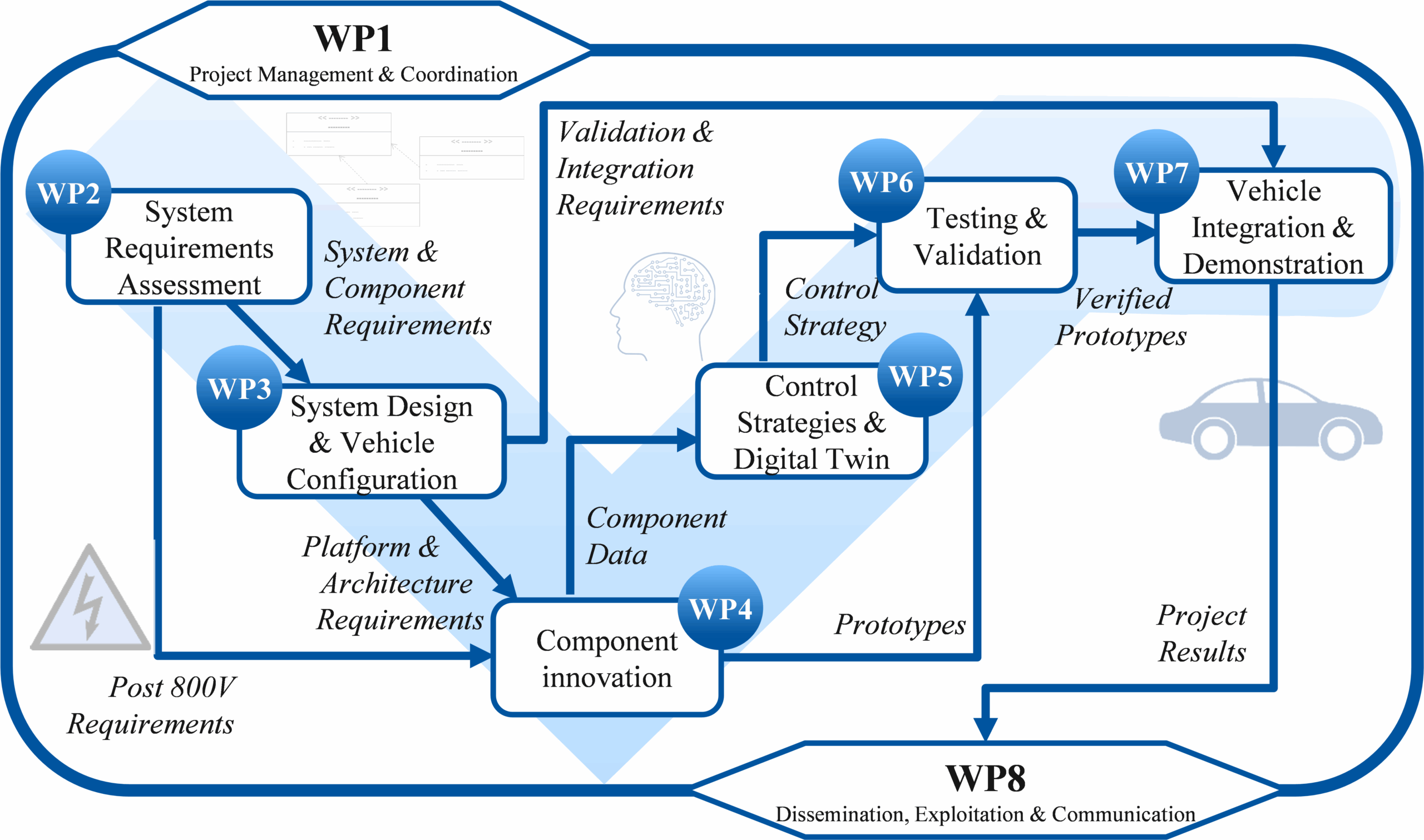
WP1 Project Management and Coordination
WP1 focuses on the overall management and coordination of the project, ensuring that objectives are achieved within the defined timelines, budget, and quality requirements.
WP2 System Requirements Assessment
WP2 defines vehicle-level requirements, evaluates system voltage levels, and establishes detailed component-level requirements to guide subsequent design and development activities.
WP3 System Design & Vehicle Configuration
WP3 addresses the system design and development of a modular, integrated powertrain architecture, including life cycle assessment (LCA) and total cost of ownership (TCO) analyses.
WP4 Component and Functionality Innovations
WP4 covers the design, development, prototyping, and testing of key powertrain innovations, including electric machine technologies, integrated chargers, advanced inverter technologies, and integrated thermal design.
WP5 Control Strategies & Digital Twin
WP5 develops high-level control and energy management strategies, including voltage utilisation approaches for machine learning–based inverter control and anti-windup restart. It also addresses coupled electric drive unit, battery, and thermal management, simulation-based control development, integration into the vehicle energy management controller, and battery and BMS control.
WP6 Testing and Validation
WP6 focuses on system-level testing and validation of the e-drive, electric machine, inverter, and charger across the full voltage range prior to vehicle integration, as well as battery and BMS testing including fast-charging validation.
WP7 Vehicle Integration & Demonstration
WP7 integrates the electric drive unit and battery into the vehicle and demonstrates key powertrain functions through testing and validation on a test track.
WP8 Dissemination, Exploitation & Communication
WP8 addresses the dissemination of project results and the development of exploitation strategies to maximise the impact and uptake of the project’s outcomes.